
Self-taught cake decorator: do you really know what you don't know?
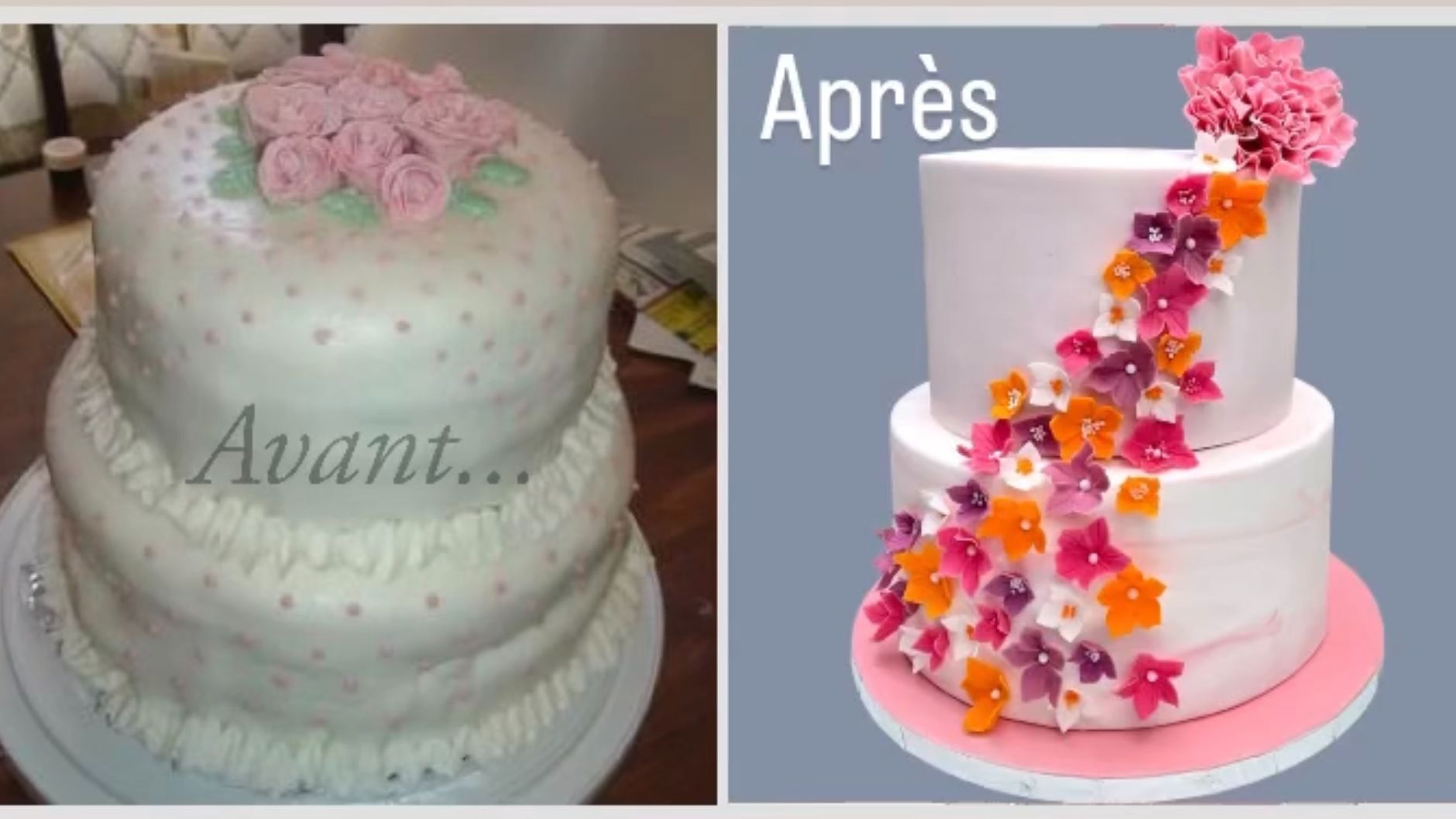
Most self-taught cake designers have one thing in common: they don't know exactly what they don't know.
That's not a criticism — it's the nature of learning on your own. You fill in the gaps as you go, work around difficulties, find shortcuts. And at some point, you feel like you have a complete practice, because you no longer see what's missing.
Here are five questions to find out where you really stand.
1. What's the internal structure of your cake? Well-built tiered cakes should hold without any problem. If yours sinks slightly in the centre or leans after a few hours, the recipe isn't the issue. It's the assembly itself.
The most common reason: layers of cream that are too thick and uneven, combined with a biscuit that's too moist. The cream keeps moving after assembly, and the cake follows.
The solution isn't to add dowels everywhere. It's to understand the balance between sponge density, cream quantity, and resting time before covering.
✳ If you can't explain why your cake holds — or why it doesn't — these foundations are worth revisiting.
2. Is your smoothing reproducible? A beautiful finish one time out of two isn't a mastered technique. It's luck.
Consistent smoothing depends on three variables many people overlook:
- the temperature of the ganache or coating cream at the moment of smoothing,
- the temperature of the room, and
- the resting time between coats.
If you sometimes get air bubbles, sometimes streaks, sometimes a flawless result — without knowing exactly why — you're repeating gestures without understanding what makes them work.
✳ If someone asked you to explain your smoothing process step by step, with the reasons behind each step, could you?
3. Does your cake survive transport? Transport is the real test. A perfect cake on the worktop that arrives damaged at the client's — that's not a professional cake.
Problems almost always come from one of three sources:
- the base (a board that's too thin or poorly secured and slides),
- the internal structure (a cream layer that's too thick, a sponge that's too fragile),
- the external structure (buttercream or ganache that hasn't rested long enough before being moved).
Sugarpaste reacts to temperature changes in the vehicle — condensation, cracking, softening.
✳ Do you have a clear transport protocol, or do you improvise each time and hope for the best?
4. Do you know the hygiene rules that apply to your activity? This is the question nobody asks. And yet it's one of the most important if you sell — or plan to sell — your cakes.
Some creams commonly used in amateur cake design don't meet the preservation standards required for commercial activity. Some elements raise regulatory issues depending on the country where you work (fresh flowers, for example). And allergen labelling is mandatory in most selling contexts, even informal ones.
✳ If a client asked you about storage or allergens, could you answer with certainty?
5. Do you know how to price your work? This isn't a question of self-confidence. It's a question of method.
A well-calculated price takes into account the cost of ingredients, the real time involved — preparation, decoration, client exchanges, delivery — equipment depreciation, and the value of your positioning. The majority of self-taught cake designers undervalue their working time by at least 40%, often because they never actually measure it.
✳ Do you know precisely how much each cake you produce costs you — and how much it actually earns you?
What this grid reveals If you hesitated on several points — or quietly answered no while reading — that's useful information, not a reason to panic.
Foundations aren't what you learn last. They're what you should have learned first.
The Les Fondations du Cake Design training at Sweet Design Academy covers exactly these five points, over two days. No shortcuts. Solid foundations, once and for all.
